Mahanoy Valley RR Yard Design & Operation | March 2026 |
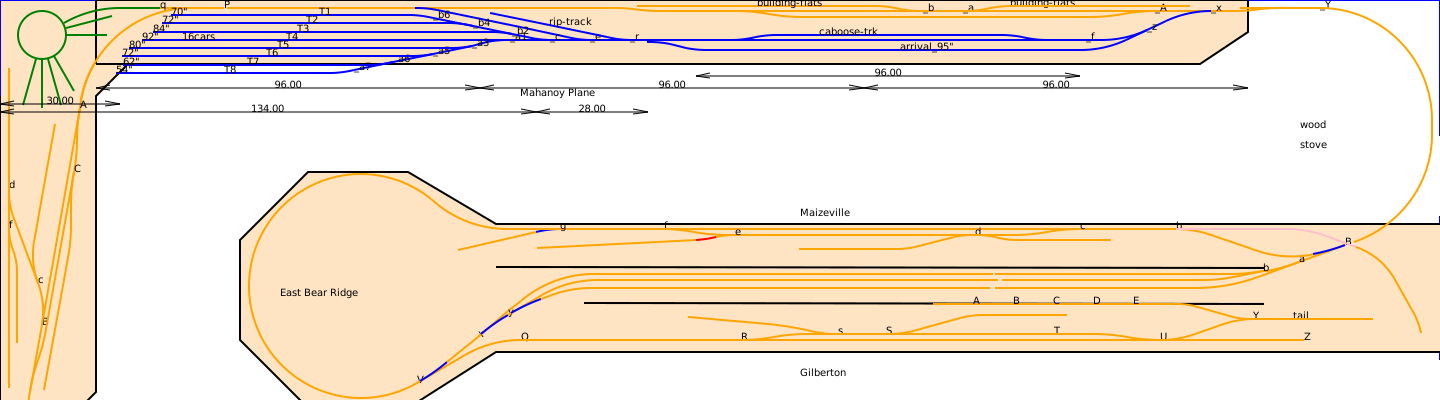
Conventional yard design (Sperandeo, Aberle, Op Sig Compendium) would have arrival and departure tracks parallel to classification tracks. The original design did that and included the use of the mainline track against the wall. But finding a place for a drill track seemed awkward and suggested a better understanding of how yards work.
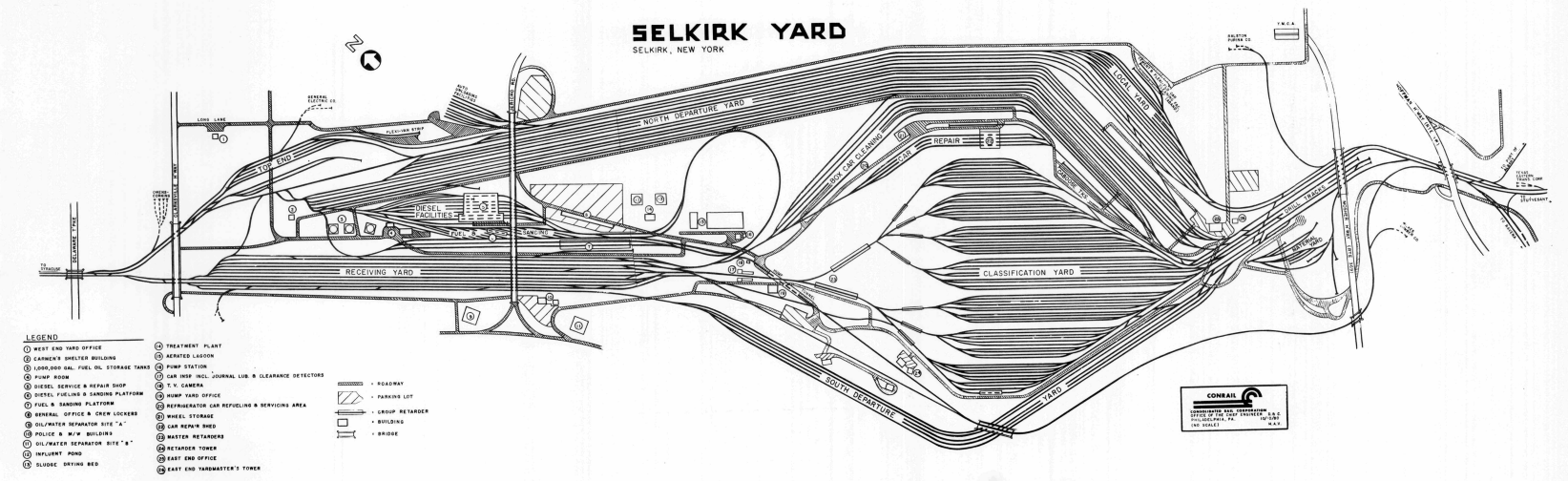
 Track diagrams for the nearby Cumberland CSX yard were
not as clear as for at Selkirk Yard which made things obvious.
Selkirk is a single yard for handling both east and westbound trains.
Its main components are a set of arrival tracks at its western end,
leading to a hump and ~70 classification tracks,
from which blocks of cars are pulled onto drill tracks at its eastern end and
pushed into departure tracks spanning the length of the yard in the north.
There is a circuitous track that allow westbound trains
to reach the arrival tracks from the eastern end.
The flow of cars seems obvious.
Track diagrams for the nearby Cumberland CSX yard were
not as clear as for at Selkirk Yard which made things obvious.
Selkirk is a single yard for handling both east and westbound trains.
Its main components are a set of arrival tracks at its western end,
leading to a hump and ~70 classification tracks,
from which blocks of cars are pulled onto drill tracks at its eastern end and
pushed into departure tracks spanning the length of the yard in the north.
There is a circuitous track that allow westbound trains
to reach the arrival tracks from the eastern end.
The flow of cars seems obvious.
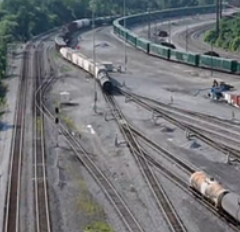
Both Cumberland and Selkirk were hump yards. Because of upgrading tunnel tracks near Baltimore, all trains were rerouted through Cumberland and the yard was modernized to handle the extra traffic.
The hump in Cumberland is replaced with a mini-hump and switching with modern freight cars having roller bearing still allows cars to roll into classification tracks. A small shack accommodates an operator who aligns switches using a modern APEX Rail Automation system and an operator for uncoupling cars at the mini-hump and controlling the loco remotely.
 With a better understanding yard design,
that more efficient yards have arrival tracks in-line with classification tracks,
instead if having just a drill track
it made sense to use that space for multiple arrival tracks.
The long shelf on the Mahanoy Valley RR makes this possible
with the yard parallel to the mainline avoiding all potential blockage.
With a better understanding yard design,
that more efficient yards have arrival tracks in-line with classification tracks,
instead if having just a drill track
it made sense to use that space for multiple arrival tracks.
The long shelf on the Mahanoy Valley RR makes this possible
with the yard parallel to the mainline avoiding all potential blockage.
Furthermore, easily rolling properly weighted cars with metal wheels makes it possible to mimic the operation at Cumberland. Depressing the yard track and maintaining a slight grade allows cars to roll into classification tracks using an uncoupling ramps just in front of the yard ladder.
As trains arrive, the road loco is uncoupled and moved to either a ready track or engine terminal. A switcher parked on the parallel caboose track couples to the east end of the train and begins pushing cars over the uncoupling ramp. The caboose can be uncoupled and switched to the caboose track. The 2nd arrival track accommodates a 2nd train. The loco of a westbound train uncouples and uses the parallel arrival track to reach the other end of the train, can switch the caboose and then move to the ready track.
Track diagrams on the wall show the locations of multiple industries on industry spurs so that cars can be blocked while in the yard.
It is surprising that such possibilities exist on such a small layout. Yard operation is expected to be relatively simple.